
What Are the Top Electric UTV Manufacturers in China?

Time:2026-10-11 Author:Oliver
0%

China has become a significant manufacturing base for electric recreational and utility vehicles. Its supply chain combines battery production, motor engineering, metal fabrication, and large-scale export logistics. However, identifying the “top” Electric Utv manufacturers requires more than comparing online prices.

The market is still developing. The data is uneven. Major research firms, including Grand View Research and MarketsandMarkets, report strong growth across electric off-road and all-terrain vehicle segments. Yet, these reports often combine utility vehicles, recreational vehicles, and low-speed vehicles. They rarely isolate Chinese Electric Utv sales with complete transparency. The International Energy Agency’s Global EV Outlook also confirms China’s broader leadership in electric mobility, although its statistics mainly cover road vehicles.

This guide therefore evaluates manufacturers through practical indicators. These include product range, battery specifications, payload capacity, drivetrain durability, factory capability, certification, export experience, and after-sales support. Official product documents matter here. A claimed 60-kilometre range means little if the vehicle carries heavy tools across steep farmland. Real performance depends on temperature, terrain, payload, tires, and driving speed. That matters.

Manufacturers such as CFMOTO, Hisun, Linhai, and other specialized Chinese OEMs deserve careful comparison. Some offer recognizable international distribution networks. Others provide flexible private-label production for overseas buyers. A perfect ranking is impossible because company disclosures differ, and independent test data remains limited. Still, combining manufacturer evidence with industry reports can reveal which companies offer credible technology, dependable support, and realistic value in China’s expanding Electric Utv market.
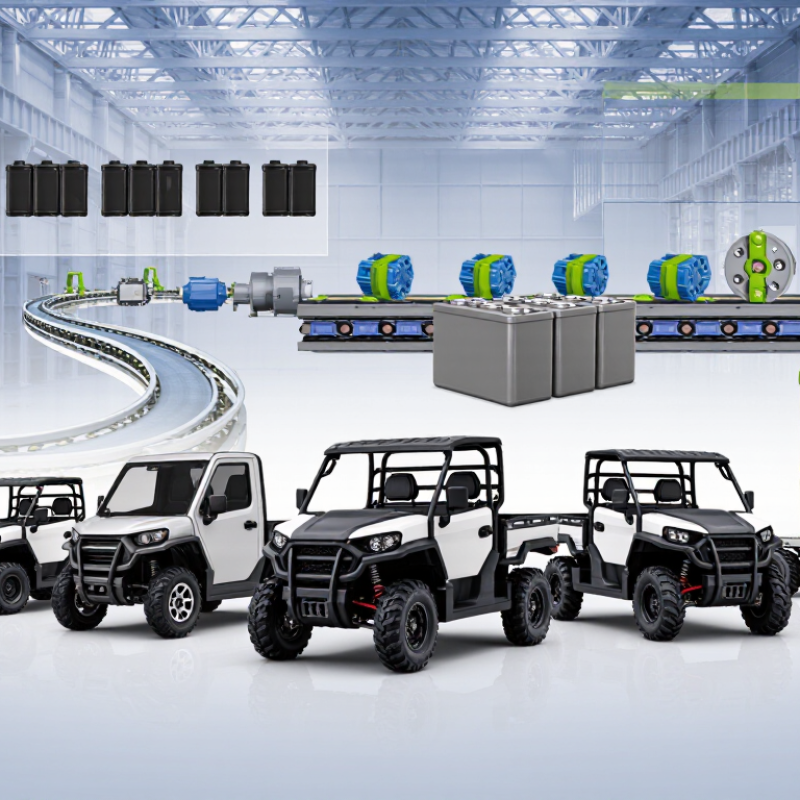
What Are the Top Electric UTV Manufacturers in China?

Definition and Key Features of Electric UTVs

What Are the Top Electric UTV Manufacturers in China?

Definition and Key Features of Electric UTVs

An electric UTV is a utility vehicle powered by rechargeable batteries and electric motors. It usually carries two to six occupants. Typical applications include farms, resorts, construction sites, and large private facilities. Unlike a golf cart, an electric UTV normally offers higher ground clearance, stronger suspension, and a larger cargo bed.

The International Energy Agency reported that global electric vehicle sales exceeded 14 million in 2023. UTVs represent a smaller niche, but this growth supports wider battery adoption. Industry forecasts from Research and Markets also identify utility vehicles as a fast-growing electric mobility segment. These reports should be read carefully. Definitions and market boundaries often differ.

Key features include instant motor torque, selectable drive modes, regenerative braking, and battery systems using lithium-ion cells. A practical model may provide 48 or 72 volts, hydraulic disc brakes, independent suspension, and 200 to 500 kilograms of payload capacity.

Ground clearance matters on wet soil and uneven gravel. Sealed electrical connectors also reduce dust and water risks.

Charging time, thermal control, and battery replacement support deserve equal attention. A dashboard showing only speed is not enough. Buyers should inspect range under realistic loads, not empty-road claims. Some specifications look impressive on paper, yet field performance can disappoint. Chinese manufacturers increasingly combine local battery supply with automated welding and road testing, but quality consistency still requires independent inspection and documented testing.

How to Evaluate Chinese Electric UTV Manufacturers

What Are the Top Electric UTV Manufacturers in China?

Evaluating Chinese electric UTV manufacturers requires more than comparing prices. A polished showroom can mislead you. Visit the factory, inspect welding points, and request production records. Check whether the manufacturer builds key systems in-house or only assembles imported parts. Battery quality deserves close attention. Ask for cell specifications, thermal protection details, charging limits, and test reports from recognized laboratories.

Request evidence of compliance with the regulations in your target market. Check vehicle identification procedures, charger safety, electromagnetic compatibility, and battery transport documentation. A reliable manufacturer should explain these requirements clearly. It should also provide drawings, spare-parts lists, warranty terms, and service response times. Vague answers are warning signs. So are unusually low quotes.

Ask for a working sample, not only catalog photographs. Test it on gravel, wet grass, steep slopes, and uneven loading areas. Measure braking distance, suspension movement, noise, and battery performance after repeated use. Speak with existing overseas customers when possible. Their comments often reveal delivery delays or weak after-sales support. I would also compare the promised range with real field results, because laboratory figures can feel optimistic. No evaluation is perfect. My own judgment can still miss hidden supplier risks. A written inspection plan makes those mistakes less likely.

What Are the Top Electric UTV Manufacturers in China? - How to Evaluate Chinese Electric UTV Manufacturers

Evaluation Dimension Weight Verified Data to Request Practical Screening Benchmark Why It Matters
Manufacturing Quality System 15% Current ISO 9001 certificate, factory audit records, incoming and final inspection procedures Certificate scope should cover the relevant vehicle or machinery production activity; audit evidence should be available A documented quality system reduces batch variation and production defects.
Battery Safety and Traceability 15% Cell supplier details, battery specification, BMS functions, UN 38.3 test summary, IEC 62619 evidence where applicable The battery pack should have over-charge, over-discharge, over-current and thermal protection, with serial-number traceability Battery design directly affects safety, operating range, service life and shipping compliance.
Vehicle Performance 12% Rated motor power, peak torque, maximum speed, gradeability, payload, towing capacity and turning radius All figures should be supported by test conditions, vehicle configuration and a signed technical data sheet Comparable test conditions prevent misleading performance comparisons.
Range and Energy Efficiency 10% Battery nominal voltage and capacity, usable energy, range-test method, terrain, load and ambient temperature Range data should identify whether it is measured at no load, rated load or under a defined duty cycle Real-world range can vary substantially with payload, slope, speed and temperature.
Chassis, Suspension and Protection 10% Frame material, suspension type, ground clearance, braking system, rollover protection and ingress-protection ratings Protection claims should identify the tested assembly and comply with the intended operating environment Durability and weather resistance are essential for agricultural, utility and off-road use.
Regulatory and Export Compliance 10% Declaration of Conformity, applicable EMC and machinery or vehicle documentation, charger compliance and shipping documents Documents must match the exact model, battery, charger and destination market Market-entry requirements differ by country; model-specific documents reduce customs and legal risk.
Customization and Engineering Capability 8% Engineering team structure, CAD drawings, prototype process, software update method and change-control records Supplier should define approval stages, sample testing and the impact of design changes on compliance A controlled development process supports reliable private-label and fleet projects.
After-Sales Service and Spare Parts 8% Warranty terms, spare-parts list, troubleshooting guides, remote support process and service response time Written warranty coverage should state duration, exclusions, labor responsibility and battery-specific conditions Service availability often determines total ownership cost more than the initial purchase price.
Production Capacity and Delivery Control 7% Monthly capacity, standard lead time, order history, production schedule and pre-shipment inspection process Capacity figures should be separated into theoretical capacity and confirmed available capacity Reliable delivery is critical for distributors, rental fleets and seasonal operations.
Total Cost of Ownership 5% Unit price, freight, duties, electricity consumption, maintenance intervals, battery replacement assumptions and residual value Compare at least a three-year operating scenario using the same duty cycle and energy prices The lowest purchase price does not necessarily provide the lowest operating cost.
Total Evaluation Weight 100% Use documented evidence, independent inspection and a production sample before final supplier approval.

Scoring method: assign each dimension a score from 1 to 5, multiply the score by its weight, and compare suppliers only after verifying equivalent vehicle configurations and test conditions.

Leading Electric UTV Manufacturers in China

China has become a major production base for electric UTVs, supported by established vehicle, battery, and component supply chains. Leading electric UTV manufacturers in China usually combine in-house assembly with carefully managed supplier networks. Their strongest products show practical engineering, not just attractive styling.

When evaluating a manufacturer, inspect battery protection, motor cooling, frame welding, and suspension alignment. Ask for test records, load ratings, charging data, and clear warranty terms. A reliable factory should explain battery chemistry, controller settings, water resistance, and replacement-part availability without vague promises. Samples should be tested on gravel, wet grass, steep paths, and uneven farmland. Details matter.

Factory visits can reveal more than brochures. Check assembly areas, quality checkpoints, serial-number tracking, and final inspection procedures. Good manufacturers welcome technical questions and provide traceable documents for safety and market compliance. Still, no factory is perfect. A polished showroom can hide inconsistent welding or rushed testing. Independent inspections remain useful, especially for overseas buyers. Delivery speed may also affect quality when production schedules become crowded. That small risk deserves attention. Manufacturers that improve after receiving test feedback often demonstrate stronger long-term reliability than those focused only on low prices.

Comparison of Products, Technologies, and Market Strengths

China’s electric UTV manufacturers generally serve three product needs: farm work, recreation, and commercial fleets. Utility models often use steel frames, cargo beds, winches, and selectable four-wheel drive. Recreational versions focus on suspension travel, seating comfort, and quicker acceleration. Fleet models usually prioritize simple controls, service access, and consistent charging performance over top speed.

Battery technology creates the clearest product difference. Lithium-ion packs reduce weight and support faster charging than lead-acid systems. A well-designed battery management system should monitor temperature, voltage, and cell balance. Some manufacturers add regenerative braking, mobile diagnostics, and removable battery modules. These features sound impressive, but software quality matters more than a long specification sheet. Buyers should inspect connector sealing, cable protection, and cooling paths before ordering.

Market strength comes from China’s dense supply chain and flexible production capacity. Manufacturers can often adjust cargo layouts, suspension settings, battery sizes, and dashboard functions for different buyers. Pricing may also remain competitive. However, lower purchase cost can hide weaker after-sales support, uncertain spare-part supply, or inconsistent testing. A practical evaluation should include hill climbing, wet-ground traction, braking distance, and real payload use. Claimed range may drop sharply in cold weather or deep mud. That is easy to overlook. Factory audits, clear warranty terms, independent safety testing, and responsive technical communication provide stronger evidence than promotional claims.

Buying Considerations for Chinese Electric UTVs

Buying a Chinese electric UTV requires more than comparing motor power and price. The IEA’s Global EV Outlook 2025 reports over 17 million electric cars sold worldwide in 2024. That growth supports better battery supply chains, but passenger-car data does not guarantee UTV quality. Public UTV statistics remain limited. Be careful with optimistic market forecasts.

Start with the working environment. A 72-volt system may suit farm paths, while steep, muddy terrain needs strong low-speed torque. Ask for continuous motor power, not only peak power. Check the battery chemistry, usable capacity, charging time, and expected performance below freezing. A 10-kilowatt-hour battery can perform differently under heavy loads. Request independent test records, not only laboratory claims.

Inspect the frame, suspension joints, brakes, waterproof connectors, and underbody protection. Look for clear ratings under relevant Chinese standards, UN 38.3 transport documentation, and battery safety test evidence. These documents support traceability, but they are not substitutes for a field inspection. The ILO and ISO safety guidance also emphasizes risk assessment around mobile machinery; apply that principle to rollover protection, visibility, and operator controls. Ask whether spare controllers, tires, and battery modules remain available for several years. Cheap parts are not cheap when downtime stops a harvest. A practical mistake is trusting the brochure before testing a loaded vehicle on your actual route. Field trials reveal weaknesses quickly.

FAQS

How can I evaluate an electric UTV manufacturer in China?

Visit the factory instead of trusting showroom photos. Inspect welding points, assembly areas, quality checks, and final inspections. Ask for production records and traceable serial numbers. No checklist catches everything.

What battery information should I request?

Ask for cell specifications, battery chemistry, thermal protection, charging limits, and laboratory test reports. Check how the battery performs after repeated use. A battery should not feel dangerously hot after normal charging.

Should I test a working sample?

Yes. Test the vehicle on gravel, wet grass, steep paths, and uneven loading areas. Measure braking distance, suspension movement, noise, and range. Catalog pictures cannot show real handling.

Which vehicle systems deserve close inspection?

Examine the motor cooling system, controller settings, frame welds, suspension alignment, and water resistance. Check the rated load and charging data. Small alignment errors can create noticeable steering problems.

What compliance documents should an overseas buyer request?

Request documents covering vehicle identification, charger safety, electromagnetic compatibility, and battery transport. Ask whether the vehicle meets your target market’s rules. Clear explanations matter. Vague answers are warning signs.

How can I judge after-sales support?

Request warranty terms, spare-parts lists, service response times, and replacement procedures. Speak with existing overseas customers when possible. Their experience may reveal delayed parts or slow technical support.

Is the lowest quotation usually the best choice?

Not always. An unusually low price may reflect weaker batteries, rushed testing, or limited support. Compare materials, testing, warranty coverage, and delivery schedules. Cheap can become expensive.

How reliable are advertised driving-range figures?

Treat laboratory range figures as estimates. Test the vehicle under real loads, slopes, wet ground, and repeated driving. Field results may be lower. My own judgment can still miss hidden supplier risks.

Conclusion

Electric Utv vehicles are practical off-road utility machines designed for agriculture, landscaping, construction, property management, and recreational use. They typically feature electric motors, rechargeable battery systems, quiet operation, low maintenance requirements, strong torque, adaptable cargo areas, and useful safety equipment. When evaluating Chinese electric UTV manufacturers, buyers should consider manufacturing experience, battery quality, motor performance, vehicle durability, testing standards, customization capabilities, after-sales support, spare-parts availability, and export service.

China’s electric UTV market includes manufacturers with different strengths in product design, production scale, technology development, and market coverage. Some focus on compact utility models, while others emphasize high load capacity, extended range, smart controls, or specialized configurations. Buyers should compare payload, towing ability, charging time, driving range, suspension, ground clearance, weather protection, warranty terms, and total ownership costs. Careful evaluation helps customers choose a reliable Electric Utv that matches their working environment, operating frequency, budget, and long-term maintenance expectations.

Oliver

Oliver

Oliver is a seasoned marketing professional with a wealth of expertise in driving brand awareness and engagement. With a deep understanding of our company's product offerings, he consistently delivers high-quality content that enriches our professional blog. His insights not only shed light on......