
How to Choose an Electric UTV in 2026?

Time:2026-10-16 Author:Amelia
0%

Choosing an electric UTV in 2026 requires more than comparing battery sizes and showroom prices. Real value appears after matching the vehicle with your land, workload, climate, and charging access. A quiet machine may suit hunting trails, farm lanes, or residential properties. It may struggle, however, under constant towing or steep, muddy conditions.

A Utv Electric model should be judged through practical specifications, not attractive marketing language. Examine usable battery capacity, motor output, ground clearance, payload, towing limits, suspension travel, and waterproofing details. Manufacturer figures provide a starting point, but independent testing and dealer explanations add valuable context. Ask how range changes with cold weather, heavy loads, hills, tire pressure, and repeated stop-and-go driving. Those details often matter more than the maximum range shown in a brochure.

Service support deserves equal attention. Confirm battery warranty terms, replacement costs, charging equipment, software updates, and local technician availability. A reliable dealer should explain limitations clearly, rather than promise effortless ownership. Short test drives can expose awkward steering, poor visibility, weak braking feel, or uncomfortable seating. Bring the tools and cargo you normally use. No choice is perfect. I would still compare several models after reading the specifications, because published data can omit inconvenient conditions. The best electric UTV is not always the fastest or cheapest. It is the one that performs predictably, charges conveniently, and remains supported throughout its working life.
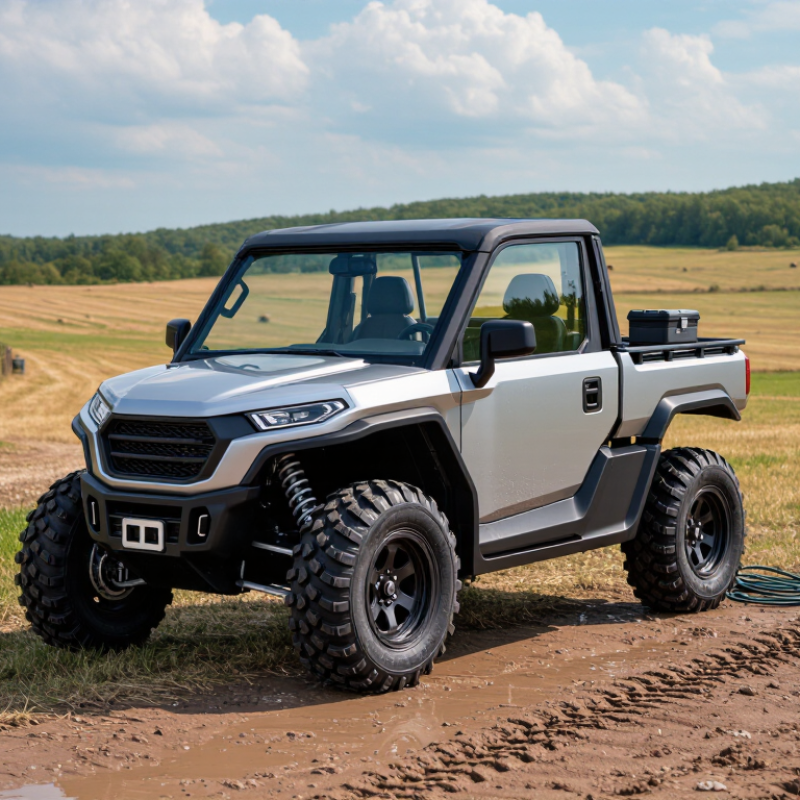
How to Choose an Electric UTV in 2026?

Define Electric UTV Use Cases with ANSI/ROHVA Classifications and Duty Cycles

How to Choose an Electric UTV in 2026?

Start with the job, not the motor. An electric UTV for trail riding faces different demands than one hauling feed daily. Use ANSI and ROHVA documentation to identify the vehicle’s intended category, seating configuration, safety equipment, and operating limits. These standards help describe design expectations, but they do not replace local rules or site requirements. A recreational model may suit uneven trails and short trips. A utility-focused model may better support cargo beds, towing, and frequent low-speed work.

Then define the duty cycle. Record daily distance, payload, trailer weight, slope, surface, temperature, and charging access. Light duty might mean two short trips with several hours between charges. Moderate duty could involve repeated hauling across muddy ground. Heavy duty may require long work periods, steep grades, and near-rated payloads. Battery capacity alone can mislead. Repeated climbs can increase heat and reduce usable range. Cold weather can also slow charging and weaken performance.

Ask for verified payload, towing, ground-clearance, water-resistance, and charging data. Check whether ratings apply to level pavement or rough terrain. That detail matters. I would also test the vehicle with real cargo, because an empty-bed demonstration proves very little. My first estimate is often too optimistic. Include a reserve of energy, especially when recovery is difficult or charging is distant. A clear duty-cycle record makes the ANSI/ROHVA classification more useful and exposes mismatches before purchase.

How to Choose an Electric UTV in 2026?

Define the vehicle’s use case with ANSI/ROHVA occupant classifications and a realistic duty cycle before selecting battery capacity, seating layout, and payload capability.

Planning basis: Light duty represents 2 operating hours at 5 kW average traction demand, moderate duty represents 4 hours at 8 kW, and severe duty represents 6 hours at 12 kW. The resulting energy values are planning scenarios, not vehicle certification ratings.

ANSI/ROHVA context: Type I is intended for an operator, Type II for an operator and front passenger, Type III for an operator with rear passenger seating, and Type IV for an operator with front and rear passenger seating. ANSI/ROHVA classifications describe vehicle configuration and occupant arrangement; they do not define battery size, range, payload, or duty-cycle limits.

Compare Battery Voltage, Capacity, Range, and Charging Time Using EPA Test Data

How to Choose an Electric UTV in 2026?

Choosing an electric UTV requires more than reading the largest battery number. Compare battery voltage, usable capacity, tested range, and charging time together. Voltage affects motor performance, especially on steep trails or when carrying heavy tools. Capacity, measured in kilowatt-hours, shows how much energy the battery stores. It does not guarantee a longer working day.

EPA test data can provide a useful reference, but only when the test method is clear. Check whether the range figure comes from an official EPA procedure or a manufacturer estimate. Test conditions may differ from real work. Cold mornings, muddy ground, hills, tire pressure, and a loaded cargo bed can reduce distance. I would also compare usable capacity, not only total capacity. That detail is easy to miss.

Tips: Ask for the complete test sheet. Check ambient temperature, payload, speed, and terrain assumptions. A short charging time may require a high-output charger and suitable electrical service. Calculate charging hours by dividing usable battery capacity by charger output, then allow for charging losses. Keep a safety margin. Maybe twenty percent. A claimed range can look impressive until the last steep hill. Also, review warranty terms, battery monitoring, and service access before choosing. These practical details often matter more than a higher voltage figure.

Evaluate Payload, Towing Capacity, Ground Clearance, and GVWR Against SAE Ratings

How to Choose an Electric UTV in 2026?

Choosing an electric UTV starts with real working numbers, not showroom claims. Check payload, towing capacity, ground clearance, and GVWR together. Payload includes passengers, tools, cargo, and added accessories. A vehicle carrying four adults may have little capacity left for a loaded bed. Measure it loaded. Numbers need context.

GVWR is the maximum permitted operating weight of the complete vehicle. Compare it with the curb weight to estimate usable payload. Do not treat the difference as a perfect working target. Battery condition, tire pressure, temperature, and uneven ground can change handling. Towing capacity also depends on the hitch, trailer brakes, tongue weight, slope, and surface conditions. SAE J2807 offers a recognized towing-test framework, but not every electric UTV uses that exact procedure. Ask how the rating was tested.

Ground clearance deserves a careful inspection. Measure the lowest fixed point, then repeat with a normal load. Suspension compression can reduce clearance more than expected. SAE terminology improves consistency, but it does not make every measurement identical. During field evaluations, I look for the test method, axle limits, and tire specification before trusting a rating. One overlooked detail is rear-axle loading from a heavy trailer. It can make a capable vehicle feel unstable. I would also leave a practical safety margin rather than operate at the published maximum every day. Some ratings look impressive on paper. Real trails are less forgiving.

How to Choose an Electric UTV in 2026? - Evaluate Payload, Towing Capacity, Ground Clearance, and GVWR Against SAE Ratings

Evaluation Dimension What the Number Means SAE Reference or Calculation Practical 2026 Screening Target Worked Evaluation Example Buying Decision
Payload Capacity The maximum combined weight of occupants, cargo, accessories, and tongue load carried by the vehicle. Payload is generally calculated as GVWR minus the vehicle's running curb mass. Confirm the manufacturer’s definition of curb mass. At least 500 lb for light utility work; 700–1,000 lb for regular hauling or multi-passenger use. GVWR: 1,650 lb − running curb mass: 1,120 lb = 530 lb available payload. Select a higher-payload configuration if two adults, tools, and cargo will be carried together.
Towing Capacity The maximum permitted gross trailer weight, including the trailer itself and its load. SAE J2807 provides standardized towing-test procedures for tow vehicles and trailers. It does not automatically certify every UTV or establish one universal UTV towing limit. 500–1,000 lb for general property maintenance; use the lower rating when terrain, temperature, or trailer brakes are unsuitable. Rated trailer limit: 1,000 lb; planned trailer and cargo: 750 lb; remaining nominal capacity: 250 lb. Do not use the maximum rating continuously on steep, loose, wet, or rocky terrain without confirming the operating limits.
Tongue Weight The downward force applied by the trailer coupler to the UTV hitch. Use the vehicle and hitch-maker limits. A common planning range is approximately 10% of loaded trailer weight, but the vehicle’s stated limit always controls. For a 1,000 lb trailer, plan for about 100 lb tongue weight only when the hitch and payload ratings allow it. Loaded trailer: 750 lb × 10% = 75 lb estimated tongue load. Subtract tongue weight from available payload; it is not “free” towing capacity.
Gross Vehicle Weight Rating (GVWR) The maximum allowable total operating weight of the UTV, including occupants, cargo, accessories, fluids, and tongue load. GVWR is a vehicle-specific rating shown on the certification label or in the owner’s documentation; it is not the same as towing capacity. Choose a GVWR that leaves at least 15% unused capacity for changing cargo, passengers, and accessories. GVWR: 1,650 lb; estimated operating load: 1,400 lb; unused margin: 250 lb or 15.2%. Avoid configurations that reach GVWR during normal work rather than only during exceptional loads.
Ground Clearance The minimum distance between the lowest vulnerable point of the loaded vehicle and the ground. SAE J1100 defines vehicle measurement terminology, but ground-clearance values must be compared using the same load condition and measurement point. 10–12 in for mixed property use; 12 in or more for rocky trails and rutted terrain. Advertised clearance: 12.0 in unladen; estimated loaded clearance: 10.8 in. Compare loaded clearance, approach angle, breakover angle, and departure angle—not clearance alone.
Approach and Departure Angles The steepest slope the front or rear of the UTV can approach without contacting the ground. These are geometric vehicle measurements rather than a universal SAE performance rating; verify how the angles were measured. Approximately 25° or more for uneven work sites; higher angles improve obstacle clearance. Front approach angle: 28°; rear departure angle: 25°. Prioritize geometry if the route includes drainage ditches, berms, rocks, or steep transitions.
Curb Mass and Load Calculation The vehicle’s running weight before adding the planned occupants and cargo. Use the same definition for every vehicle: battery, standard fluids, required equipment, and installed accessories should be identified. Request a measured or documented running mass instead of relying only on a dry weight. Running curb mass: 1,120 lb; two occupants: 360 lb; cargo: 250 lb; operating mass: 1,730 lb. Reject the configuration if calculated operating mass exceeds GVWR.
Battery Energy and Usable Range Battery capacity affects working time, but terrain, load, temperature, speed, tire pressure, and towing can substantially change range. Usable battery energy is more meaningful than nominal energy. Compare range using a defined work cycle rather than a single ideal-condition figure. For regular work, target at least 1.5 times the planned shift energy requirement. Nominal battery: 20 kWh; estimated usable energy at 90%: 18 kWh; planned shift use: 11 kWh; reserve: 7 kWh. Ask for cold-weather, towing, and loaded-range data before sizing the battery.
Gradeability Under Load The ability to climb a slope while carrying the intended load, at a stated speed and surface condition. A grade percentage is not the same as an angle: angle = arctangent(grade ÷ 100). A documented 25–30% sustained grade under working load suits many properties; verify the operating manual. 30% grade corresponds to approximately 16.7°; this is a calculation, not a universal UTV rating. Use the manufacturer’s loaded-grade limit and reduce speed on loose or wet surfaces.
Braking and Trailer Control Stopping performance depends on total mass, slope, surface, tires, brake system, and whether the trailer has its own brakes. Do not infer braking capability from motor power. Check the owner’s manual, hitch instructions, and applicable local trailer-brake rules. For frequent heavy towing, prefer a documented trailer-brake solution and a controllable low-speed drive mode. Planned trailer: 750 lb; confirm whether trailer brakes are required by local law and supported by the vehicle. Treat towing, braking, and downhill control as one system rather than separate specifications.

Note: SAE references provide measurement terminology or test procedures; they do not create one universal payload, towing, ground-clearance, or GVWR rating for every electric UTV. Always verify the vehicle certification label, owner’s manual, hitch documentation, and local operating requirements.

Check Motor Power, AWD Systems, Brakes, IP Ratings, and Safety Standards

How to Choose an Electric UTV in 2026?

Choosing an electric UTV in 2026 starts with motor power, not a glossy range number. Match torque to hills, payload, and loose ground. A 10–15 kW system may suit property work. Heavier loads and steep trails need stronger continuous output, not only peak power. Test acceleration with a full bed if possible. Some vehicles feel powerful briefly, then soften under heat. That detail matters.

An AWD system should engage smoothly on mud, gravel, and uneven slopes. Check whether it offers selectable modes or automatic control. Brakes deserve equal attention. Look for hydraulic disc brakes, a dependable parking brake, and controlled regenerative braking. Regeneration should support stopping, not replace mechanical brakes. Confirm the battery, controller, and motor IP ratings before riding through wet grass or shallow water. A higher rating helps, but seals can age. Review service records and inspection guidance.

Safety standards vary by region, so request clear compliance documents. Check seat belts, rollover protection, lighting, mirrors, and emergency isolation controls. Ask whether the frame and restraint system were tested together. Marketing claims are not enough.

Tips: Compare continuous motor output, not peak figures. Inspect brake lines and connectors in person. Bring your usual load. I would also budget for tire and battery checks, because early estimates can be too optimistic. Safety equipment still needs regular adjustment.

Calculate Total Cost of Ownership from Battery Warranty, Energy Rates, and Maintenance Data

How to Choose an Electric UTV in 2026?

Total cost of ownership starts with measured energy use, not brochure range. Record charger electricity for several work cycles, including hills, towing, and winter starts. Multiply annual kilowatt-hours by your local tariff. The U.S. Energy Information Administration reported an average residential electricity price of about 16.5 cents per kWh in 2024. A vehicle using 2,400 kWh yearly would therefore cost about $396 before charging losses. Add roughly 10–15% for charging inefficiency, unless your meter provides wall-to-battery data.

Battery risk needs a separate worksheet. Compare warranty years, mileage or hour limits, capacity-retention thresholds, transfer rules, and labor coverage. A warranty promising capacity protection is more useful than a simple time period. NREL research on lithium-ion batteries shows that temperature, charging behavior, and duty cycle strongly affect aging. UTV data can differ. Treat passenger-vehicle studies as guidance, not proof.

Maintenance is usually lower, but never zero. The U.S. Department of Energy reports that electric vehicles generally need less scheduled maintenance because they lack oil changes and complex engine systems. Still budget for tires, brakes, suspension joints, belts, cooling components, and software diagnostics. I once underestimated tire wear by using road-vehicle assumptions. That was a poor shortcut. Use service invoices from comparable working UTVs, then add a 10% contingency. Divide the purchase price, financing cost, electricity, maintenance, and expected battery reserve by planned operating hours. The cheapest purchase price may not produce the lowest hourly cost.

FAQS

How should I compare battery voltage and capacity?

Voltage affects motor response on steep trails and under heavy loads. Capacity measures stored energy in kilowatt-hours. Higher capacity does not guarantee a longer workday. Compare usable capacity, not only the advertised total.

Can official EPA range data predict real working distance?

It provides a useful reference when the test method is clear. Mud, hills, cold air, low tire pressure, and cargo can reduce range. Ask for the complete test sheet. A claimed range may fail on the final steep hill.

How can I estimate charging time?

Divide usable battery capacity by charger output. Then allow for charging losses. A 40-kWh usable battery with a 10-kW charger needs more than four hours. Keep a practical margin.

What details should I check before choosing a charger?

Confirm charger output and electrical service requirements. A fast charger may need upgraded wiring. Check whether the site can supply power safely during peak use. The shortest charging claim may hide extra installation work.

How do payload and GVWR affect daily operation?

Payload includes passengers, tools, cargo, and accessories. Compare GVWR with curb weight for a rough payload estimate. Do not treat the difference as a perfect daily target. Four adults can leave little bed capacity.

What should I examine when evaluating towing capacity?

Ask how the rating was tested. Check hitch limits, trailer brakes, tongue weight, slope, and surface conditions. A heavy trailer can increase rear-axle loading. That may make the vehicle feel unstable.

How should I inspect ground clearance?

Measure the lowest fixed point with a normal working load. Suspension compression can reduce clearance unexpectedly. Check tire specifications and axle limits. Paper measurements can look better than real trail clearance.

How can I calculate total ownership cost?

Record electricity use across hills, towing, and cold starts. Multiply annual kilowatt-hours by your local electricity rate. Add charging losses, maintenance, financing, and battery reserves. Include tires, brakes, suspension parts, cooling components, and diagnostics.

What battery warranty details deserve close attention?

Compare warranty years, operating-hour limits, capacity-retention thresholds, transfer rules, and labor coverage. Capacity protection matters more than time alone. Temperature and charging habits affect battery aging. I once trusted a simple warranty period too much. That was a poor shortcut.

Conclusion

Choosing an Utv Electric in 2026 starts with matching the vehicle to your real work and recreation needs. Define expected terrain, passenger use, load frequency, and operating hours, then use ANSI/ROHVA classifications and duty cycles to identify the appropriate vehicle category. Compare battery voltage and capacity alongside realistic range and charging time, giving preference to transparent EPA test data while allowing for differences caused by temperature, payload, terrain, and driving style.

Next, verify payload, towing capacity, ground clearance, and GVWR against relevant SAE ratings and your intended tasks. Examine motor output, selectable or automatic AWD, braking performance, water and dust protection through IP ratings, and available safety equipment. Finally, calculate total cost of ownership rather than focusing only on purchase price. Include battery warranty coverage, local electricity rates, charging equipment, scheduled maintenance, consumables, and likely battery replacement costs. A careful comparison will help you select a capable, safe, efficient, and financially practical electric utility vehicle.

Amelia

Amelia

Amelia is a seasoned marketing professional with a wealth of expertise in our company’s core offerings. With an unwavering passion for driving growth and innovation, she plays a pivotal role in shaping our marketing strategies and enhancing brand visibility. A key aspect of her responsibilities......