
Farming demands equipment that works before sunrise and keeps working after a long, muddy day. An Electric Farm Utv can reduce fuel use, simplify routine transport, and move quietly around livestock, crops, and storage buildings. However, electric performance depends heavily on terrain, payload, temperature, and charging access.
This guide examines seven leading electric farm UTVs for 2026. We compare battery capacity, working range, towing strength, ground clearance, cargo design, charging time, and service support. Manufacturer specifications provide a useful starting point. Real farm conditions provide the harder test. A vehicle rated for smooth paths may struggle on wet clay or steep pasture tracks.
Details matter here.
A useful UTV should carry feed bags without feeling unstable. It should cross uneven ground without excessive wheel spin. Controls should remain practical when the operator wears gloves. We also consider battery warranties, replacement costs, dealer availability, and maintenance requirements. These factors often matter more than impressive showroom figures.
No single model fits every farm. Some offer strong torque but limited range. Others provide excellent comfort while sacrificing cargo capacity. That trade-off can be easy to overlook. Our selections aim to balance documented specifications with realistic agricultural use, while recognizing that local weather and workload may change the result. Treat this list as a careful buying guide, not a promise that every machine will perform perfectly everywhere.
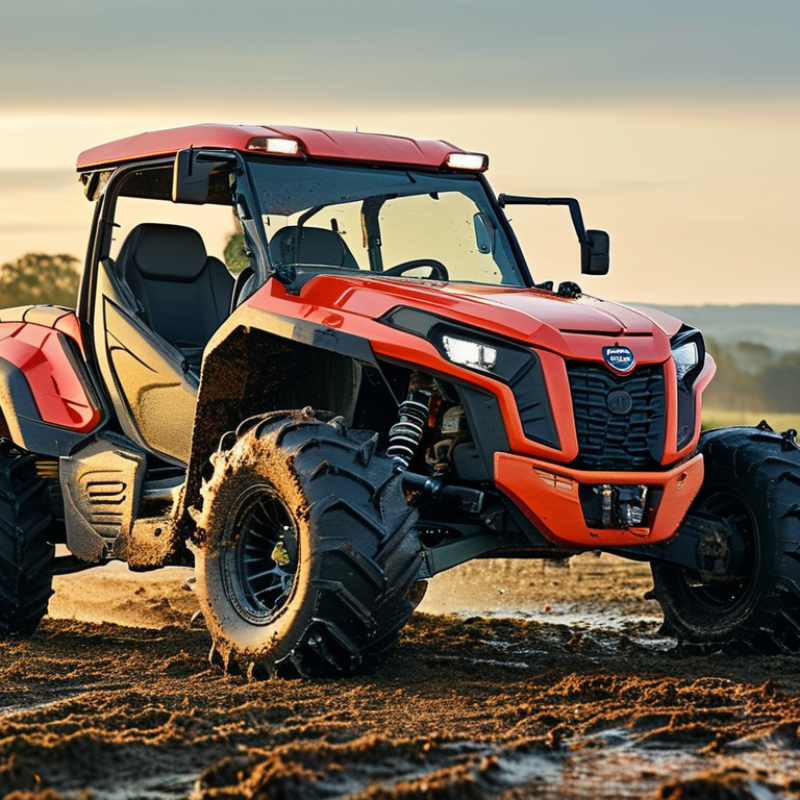
Electric farm UTVs are utility vehicles powered by rechargeable battery packs instead of gasoline or diesel engines. Electricity flows from the battery to an inverter, which controls one or more electric motors. Those motors turn the wheels through a direct or geared drivetrain. The system usually includes selectable two- or four-wheel drive, electronic speed control, and regenerative braking.
Quiet operation matters around livestock and early-morning work. Electric motors also deliver strong low-speed torque, helping a loaded UTV move across muddy lanes. The U.S. Department of Energy reports that electric motors can exceed 90% efficiency, while conventional gasoline engines typically convert only 20% to 30% of fuel energy into motion. That difference can reduce operating losses, though battery charging still depends on electricity prices and grid conditions.
A farm UTV’s real performance depends on battery size, terrain, payload, temperature, and towing. The International Energy Agency reported more than 14 million electric cars sold globally in 2023, showing how battery technology is scaling beyond small consumer devices. Yet farm use is harsher. Dust, standing water, and long idle periods expose weak designs quickly. Charging overnight may suit routine chores, but heavy hauling can shorten the working range sharply. A larger battery adds weight and cost. That trade-off is easy to underestimate. Checking daily routes, outlet capacity, and charging time is more reliable than trusting a single range number.
| Rank | Electric Farm UTV Type | Best Farming Use | Drive System | Battery System | Typical Working Range | Payload Capacity | Towing Capacity | Ground Clearance | Typical Charge Time | How It Works on a Farm |
|---|---|---|---|---|---|---|---|---|---|---|
| 1 | Heavy-Duty 4x4 Electric Farm UTV | General farm transport, livestock work, hauling feed, and field maintenance | Selectable 2WD/4WD | 48–72 V lithium-ion 15–30 kWh |
30–60 miles (48–97 km) |
1,000–1,500 lb (454–680 kg) |
1,500–2,500 lb (680–1,134 kg) |
10–14 in (25–36 cm) |
4–10 hours with AC charging |
The battery sends direct-current power to one or more electric motors. Instant motor torque helps the vehicle climb muddy slopes and pull trailers without engine idling. |
| 2 | Long-Range Electric Utility UTV | Large properties, remote fields, fence inspection, and daily farm rounds | Electronic 4WD | 72 V lithium-ion 20–30 kWh |
50–80 miles (80–129 km) |
900–1,400 lb (408–635 kg) |
1,500–2,000 lb (680–907 kg) |
10–13 in (25–33 cm) |
5–12 hours depending on charger |
A larger battery stores more usable energy for extended routes. Regenerative braking can recover some energy when descending hills or slowing with a loaded trailer. |
| 3 | Compact Two-Seat Electric UTV | Small farms, poultry operations, greenhouses, barns, and short-distance hauling | 2WD or light-duty 4WD | 48 V lithium-ion 7–15 kWh |
25–50 miles (40–80 km) |
800–1,200 lb (363–544 kg) |
1,000–1,500 lb (454–680 kg) |
8–11 in (20–28 cm) |
3–8 hours with standard AC charging |
A smaller motor and battery reduce operating weight and energy use. The quiet drivetrain is useful around animals, buildings, and workers. |
| 4 | Four-Seat Crew Electric UTV | Moving workers, inspecting crops, orchard supervision, and farm tours | Selectable 2WD/4WD | 48–72 V lithium-ion 15–30 kWh |
35–70 miles (56–113 km) |
1,000–1,500 lb (454–680 kg) |
1,500–2,500 lb (680–1,134 kg) |
10–14 in (25–36 cm) |
4–10 hours depending on battery size |
The motor controller regulates torque and speed electronically, allowing smooth low-speed operation while carrying several passengers or equipment. |
| 5 | Narrow Electric Orchard UTV | Vineyards, orchards, specialty crops, and narrow rows between plants | 2WD or compact 4WD | 48–72 V lithium-ion 10–20 kWh |
30–60 miles (48–97 km) |
700–1,200 lb (318–544 kg) |
1,000–1,800 lb (454–816 kg) |
8–12 in (20–30 cm) |
4–9 hours with AC charging |
The narrow chassis improves row access. Low-speed electronic control makes it easier to drive accurately near trunks, trellises, irrigation lines, and crops. |
| 6 | High-Clearance Electric Field UTV | Uneven ground, tall crops, rough pasture, and wet field access | Full-time or selectable 4WD | 72 V lithium-ion 20–30 kWh |
30–60 miles (48–97 km) |
900–1,400 lb (408–635 kg) |
1,500–2,500 lb (680–1,134 kg) |
12–15 in (30–38 cm) |
5–12 hours depending on charger |
Independent suspension and electric torque help maintain traction over ruts and loose soil. Battery placement low in the chassis can also lower the center of gravity. |
| 7 | Multi-Use Electric Cargo UTV | Material delivery, mineral feed, fencing supplies, tools, and utility attachments | Selectable 2WD/4WD | 48–72 V lithium-ion 12–25 kWh |
30–55 miles (48–89 km) |
1,000–1,500 lb (454–680 kg) |
1,500–2,500 lb (680–1,134 kg) |
9–13 in (23–33 cm) |
4–10 hours depending on battery size |
A programmable controller matches motor output to the load. Many utility layouts support removable beds, dump boxes, winches, sprayers, or other low-voltage accessories. |
: Small properties need compact, narrow vehicles for orchards, vineyards, and greenhouse paths. They turn tightly. Larger properties need longer range, higher clearance, four-wheel drive, and stronger cargo beds. A small vehicle may waste time between distant fields.
Choose low-speed control, washable flooring, and a practical payload. The cargo area should carry feed without feeling unstable. Easy cleaning matters after muddy mornings.
Select lockable storage and enough bed length for posts and tools. Check whether long materials stay secure during turns. Short beds can become frustrating.
Look for stable handling, clear visibility, and safe mounting points for approved equipment. Keep the load balanced. Avoid raising the center of gravity unnecessarily.
Yes, especially when carrying firewood, mineral bags, or heavy tools. Four-wheel drive and strong low-speed performance can help on slopes. Top speed is often less useful.
Install charging equipment on a dedicated circuit when necessary. Use a dry, ventilated location away from dust, chemicals, and standing water. Overnight charging is usually practical. Farm electricity can be unpredictable.
Mud, hills, cold mornings, towing, and heavy loads reduce usable range. Published figures are only estimates. I would not trust them blindly. Track distance and charging time during real work.
Rinse muddy areas gently and dry charging connectors before use. Check tire pressure, brakes, suspension bolts, and electrical cables regularly. Inspect the battery and motor warranty terms. One missed inspection can become expensive.
Keep a simple log of load weight, distance, charging time, and unusual noises. Record performance on slopes and cold days. Your assumptions may change. Real farm data is more useful than guesses.
Electric Farm Utv models are practical, low-noise work vehicles designed to help farmers transport tools, feed, crops, fencing materials, and other supplies across fields and rural properties. This guide explains how electric drivetrains, batteries, motors, and charging systems work, while highlighting the key features buyers should compare, including payload capacity, towing strength, ground clearance, range, traction, safety equipment, weather protection, and ease of operation.
The article reviews seven strong Electric Farm Utv options for farming in 2026 without focusing on brand names, then matches different vehicle capabilities to tasks and property sizes. It also provides practical advice for choosing the right model, estimating daily power needs, setting up safe charging, extending battery life, performing routine maintenance, and preparing the vehicle for changing weather and demanding farm conditions.
